
Pinot noir and his clones

Origin:
Pinot noir belongs to the Pinot family. The differnces to Pinot gris and Pinot blanc are that small, that they can only be divided by the colour of the berries.These Pinot varieties are very popular in the Burgundy region in France, from where the came to nearly every wine growing region of the world. Pinot noir is called the king of the cool climate red wine varieties.
Synonyms:
Spätburgunder, Blauburgunder, Klevner
Requirements to the vineyard site:
Pinot noir needs in cool climate regions good slopes to get really ripe, otherwise the acidity will keep to high. The differences between day and night temperatures will give Pinot noir his excellent flavour.
Spread:
Pinot noir is the most famous red wine variety of the cool climate wine regions. It can be found in most of the wine growing regions of the world. Most plantings are in France, Germany, Austria, North America and northern Italy. Also in a lot of sparkling wine Pinot noir is used (e.g. Champagne).
Clones:
Pinot noir is a very mutable variety, so there are a lot of different clones with really different characteristics. The new aims for new clones for wines are small or mixed size berries so that the bunches are loose and more or less botrytis resistant.
traditional clones
In Germany, we call clones traditional clones, which have the well known Pinot noir grape shape (big bunches, dense). Until 2000 these clones were planted for more then 90% of the Pinot noir plantings.
FR 52-86
This clone of the Weinbauinstitut in Freiburg was the most planted clone in Baden until middle of the 1990s. A good quantity and very good wine quality were the main reson for this. The main disadvantage, high susceptibility to Botrytis were the reason for the end of this period. If you are able to minimize the Botrytis problem with measures like bunch dividing or the use of giberellic acid, it is, because of the good wine quality, still a very good option.


F 105
This is an older clone of the german Pinot noir clonal breeder Frank. It is still one of his clones with the loosest bunches, but in years with bad weather at flowering time, it has great problems with coulure. In the last years it was nearly completely replaced by the successive clone Frank 105-S.


F 105-S
It is a selection of the older clone Frank 105 which was in the beginning called F 105/54.
Until about 2006 it was nearly a standard clone in the Baden wine growing region and also in Germany. It is, concerning yield and sugar content, quite close to the clone FR 52-86 but with definitely less problems with Botrytis.


Frank Classic
This is a selection ut of the old clone Frank 106. This was a clone with big berries and very dense bunches, so it had big problems with Botrytis. Because of this Frank 106 is no longer planted. The bunches of this new clone Frank classic are definitely looser then Frank 106. Sometimes it takes a few years unles the clone show this looseness.


Frank Charisma
This is a selection out of Frank 105. It is quite similar to the clone Frank 105-S. Only in question of yield it seems that Frank Charisma produces a bit less. In the beginning this selection was called F 105/7/3.


Frank Vision
This is also a selection out of Frank 105. In our trials it is a bit more loose then F 105-S. Yield seemts to be a bit less. A relatively new selection which was called F 105/7/5. In years with very bad weather at flowering time, there could be a problem with coulure, but we never had quanitities less then 100 kg/ar. We think a selection worthwhile to keep in mind


Loose bunch clones
Loose bunch clones are divided into two groups, the Mariafeld types and the Non-Mariafeld types.
Mariafeld types:
Clones descending from a Pinot noir variation in Switzerland we call Mariafeld clones. These clones are all very vigorous with long and loose bunches, big berries and higher acidity then traditional clones. They were increasingly planted in Germany from the beginning of the 90s. Sometimes they are discussed quite controversial, because of the high acidity and the more lean wines.
They have the great advantage, that also in years with high humidity before harvesting time, they don't get Botrytis, so it is still possible to make red vine.
Because of their resistance to Botrytis and the high acidity they suit very well for sparkling wines.
FR 12 L
This is a typical member of the Mariafeld group. With it's very loose bunches and relatively big berries it is quite good resistant against Botrytis.


FR 13 L
This clone is quite similar to FR 12 L. Procutivity is even a bit higher and acidity a bit lower (0.5 - 1 g/l).


We M 1
This is the Mariafeld type clone of the LVWO Weinsberg. It was the first Mariafeld clone, propagated in Germany.


1- Gm group
The clones of this group look quite similar to the Mariafeld clones. Bunches could be a little bit shorter then the ones from the Mariafeld clones. The big difference is the lower acidity.
To these group belong al the Pinot noir clones of the "Forschungsanstalt Geisenheim" which start with 1-. The differences in this group are quite small.


Mixed-size berry clones
This group of clones has bunches with mixed berry size's. Because there are also very small berries the bunches doesn't get that tight. So they are more resistant to Botrytis. Also the wines you get out of this grapes have a very good colour and good structure, because the relation of skin to must is very good
Gm 20- group
These are also clones of the Forschungsanstalt Geisenheim. They always have shot berries. Because of this they should not be grafted on too vigorous rootstocks and not planted on vigorous soils.
20-13 Gm
This is a typicall member of this group with mixed-size berries. It is the one with the highest yield.

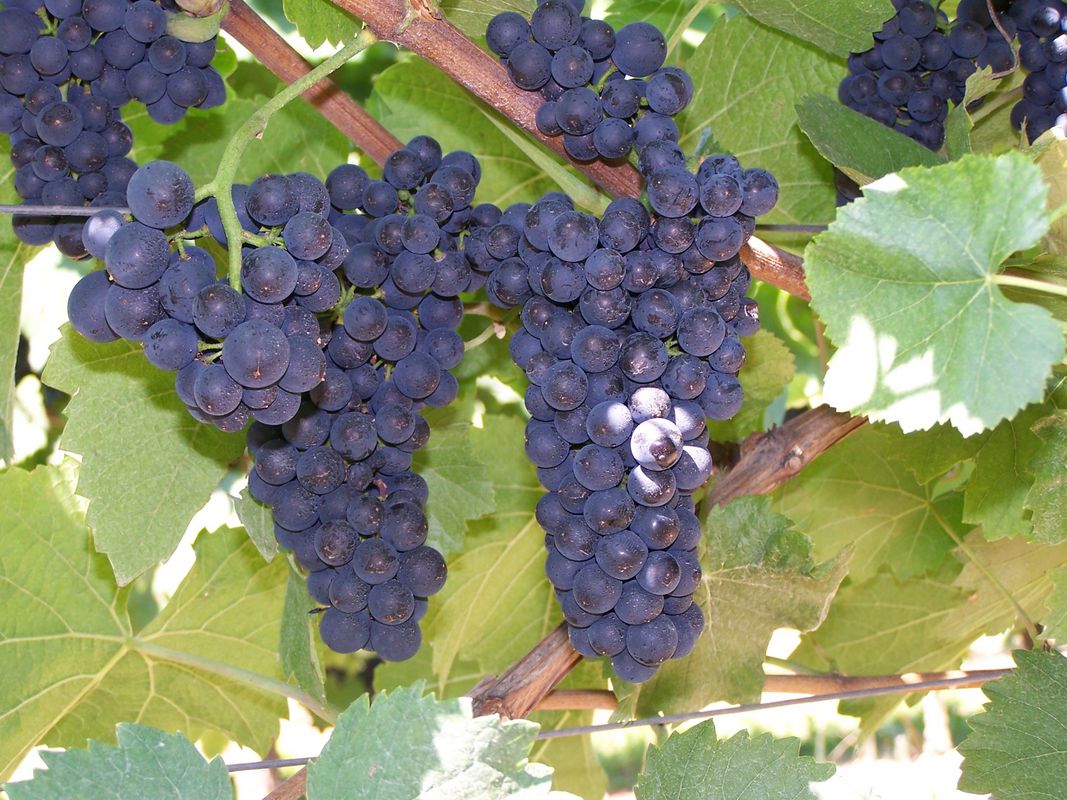


20-19 Gm
This clone is quite similar to Gm 20-13, but it can have even more of this small berries. So the producitivity is less


Freiburg 14- group
This group show the typicall characteristics of the mixed-size berries clones, but sometimes not that clear as for example Gm 20-13.
Originally this group consisted of the following clones:
Name | old Name |
FR 1401 | EA 86-1 |
FR 1402 | EA 86-3 |
FR 1403 | EA 86-6 |
FR 1404 | EA 86-11 |
FR 1405 | EA 94-062 |
FR 1406 | EA 96-126 |
It seems, that only Fr 1401 will be propagated in future, because it is the best one of this group.




Freiburg 18- group
In addition to the characteristics of the mixed-size berries clones, the berries of this group are selected on being more aromtic. As a result the wines are very tight and have a very good colour. We think possibly the most promising Pinot Noir clone of the Weinbauinstitut in Freiburg.
Originally this group consisted of the following clones:
Name | old Name |
FR 1801 | EA 94-27 |
FR 1802 | EA 94-28 |
FR 1803 | EA 94-29 |
But it seems, that only th FR 1801 will be propagated in the future.
FR 1801
Since 2007 this clone became, together with clone F 105-S, the most planted Pinot Noir clone in Baden, maybe also in Germany.
Very good resistance to Botrytis because of the loose bunches and good but not too high productivity on one side and very good wine results with very good sugar content and very good colour on the other side are the reason for this.


Small clustered and tight
This types have smaller bunches, but they are mostly very tight and therefore susceptible to Botrytis.
Mostly these are so called Pinot types which originate from Burgundy.
ENTAV-INRA 115
This is an old clone from burgundy, who always brought good wines. Because it is very susceptible to Botrytis it is very rarely planted in Germany


ENTAV-INRA 777
This is a selection auf auf clone 115. It is a little bit looser than this with also very good wine reviews.
Because of it's very good wine results it is often used for high quality red wines with barrel ageing. The prouctivity is less then most of the standard-clones.


Pinot droit type clones
Pinot droit types are clones which grow straight upright. The foliage treatment is definitely easier. Another characteristic is that the leaves also stand upright, so that the fruiting zone is relatively free of leaves, which could sometimes be an advantage in Botrytis management.


Freiburg 16- group
This group consists of the following clones:
Name | old Name |
FR 1601 | EA 86-8 |
FR 1602 | EA 86-10 |
FR 1603 | EA 86-13 |
FR 1604 | EA 86-14 |
FR 1605 | EA 96-066 |
FR 1606 | EA 96-093 |
This group combines the advantages of the Pinot droit types with slightly loose bunches. But the looseness by far not that good as it is at the mixed-size berries clones. For the moment FR 1604 s the most planted clone of this group.


